

Stop Losing Margin: Closed-Loop Control in PVC Pipe Extrusion
- How intelligent process control turns hidden material loss into measurable margin improvement
PVC pipe extrusion plants rarely lose profitability through one dramatic event. More often, margin disappears quietly, through slightly excessive wall thickness, repeated manual corrections, gradual die imbalance, changing material behavior, and unstable output. Each deviation may seem small, but over thousands of tonnes of annual production, the cumulative cost can be substantial. The central challenge is therefore not simply producing pipe. It is producing every meter consistently, close to the target specification, with minimal intervention and avoidable material consumption.
 Many producers deliberately operate above the minimum specification to reduce the risk of underweight pipe. This safety margin protects quality, but it also embeds unnecessary material cost in every product. Consider a plant producing 10,000 tonnes annually, with material costing ₹1 lakh per tonne and an average overweight of 6%. This represents 600 tonnes of additional material, worth approximately ₹6 crore. If closed-loop control reduces the average overweight from 6% to 3%, the potential saving would be around 300 tonnes, or ₹3 crore per year. Actual results depend on the product mix, dimensions, material prices, line utilization, and current process stability, but the principle remains clear: unnecessary kilograms directly erode margin.
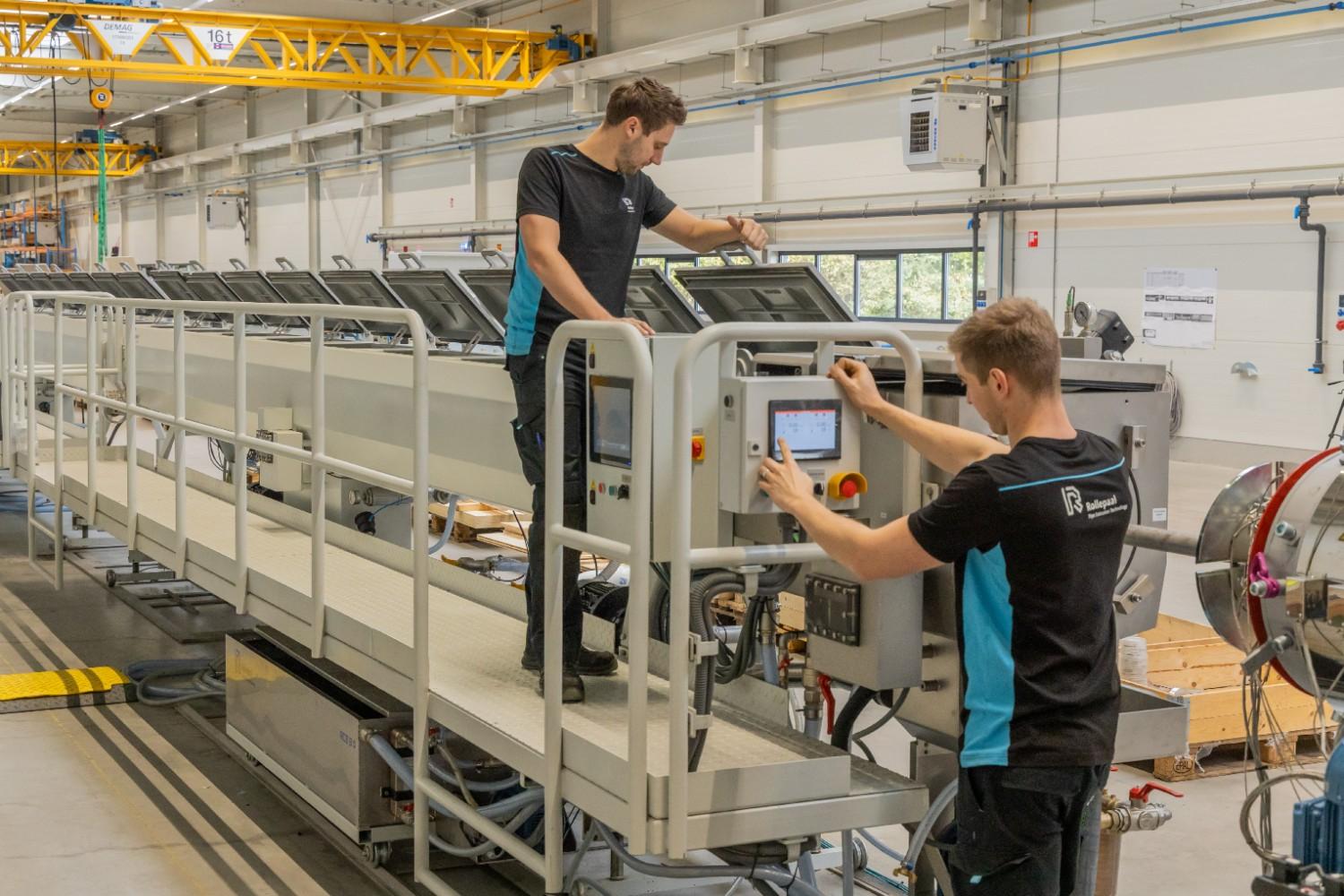
Manual intervention alone cannot eliminate this loss. Skilled operators remain essential, yet even the most experienced team cannot continuously detect, interpret and correct every disturbance during long production runs. Wall-thickness drift, temperature variation, changing bulk density, and output fluctuations can develop between checks. By the time the deviation becomes visible, hundreds of meters may already have been produced outside the optimum range. Closed-loop automation changes this dynamic by continuously measuring critical variables, comparing them with set targets, and automatically adjusting the process. Instead of waiting for a correction, the line becomes self-correcting.

Rollepaal combines three complementary control loops to support stable, efficient PVC pipe production: Meter Weight Control, Automatic Thermal Centering, and Gravimetric Output Stabilization.
Meter Weight Control addresses overweight drift. Using wall-thickness measurement, the system automatically adjusts haul-off speed to maintain the required pipe dimensions. The value lies not only in seeing the deviation, but in correcting it immediately. Producers can run closer to the target specification, reduce raw-material consumption and maintain greater consistency over long runs. The opportunity is especially significant in large-diameter production, where even a small amount of unnecessary wall thickness adds considerable material cost.
Automatic Thermal Centering stabilizes wall-thickness distribution around the pipe circumference. Uneven walls are often linked to thermal imbalance in the die head, traditionally requiring repeated operator adjustments. Rollepaal’s system uses wall-thickness data to continuously control individual die-head temperature zones. It corrects wall distribution while the line remains in production, supports faster and more stable start-ups, and reduces the need for manual die adjustments. The result is consistent geometry with fewer interruptions and less dependence on individual operator experience.
Gravimetric Output Stabilization controls the material throughput that stable pipe dimensions depend on. PVC dry blend can behave differently from batch to batch, and changes in bulk density or dosing can disrupt extruder output. Gravimetric equipment continuously measures actual throughput and adjusts dosing to keep output consistent. By compensating for material variation at its source, the system reduces process fluctuation, supports smoother downstream operation, and gives the other control loops a more stable foundation.
Together, these technologies transform extrusion from reactive firefighting into controlled production. Operators retain oversight and process expertise, but repetitive corrections are handled automatically and earlier. This enables personnel to focus on quality, optimization, and exception management rather than constantly chasing the process. It also makes performance more repeatable across shifts, improves resilience when experienced labor is scarce, and helps shorten the path from start-up to stable production.
For plant managers, the benefits are practical: less scrap, fewer adjustments, steadier runs and more predictable product quality.
For business leaders, the outcome is strategic: lower material overconsumption, stronger margins, and a production system that delivers consistent results with less variability.
The fastest line is not necessarily the most profitable; the line that stays stable and produces close to target often creates greater value.
A useful first step is to quantify the hidden loss already present in the process. Multiply annual production volume by material cost and average overweight percentage. The result provides an estimate of the annual material value being consumed above target. From there, producers can assess how closed-loop control could recover part of that value while strengthening quality and operational consistency. Because the three loops address dimensions, wall distribution, and material throughput as one connected process, improvements are reinforced rather than isolated. This integrated approach creates a stable operating window in which every measurement can trigger the appropriate response, helping the line remain close to target even when conditions change.
In today’s market, where raw-material costs, quality demands, and pressure on skilled labor continue to rise, process stability is more than an engineering advantage. It is a margin advantage.Learn more about Rollepaal’s closed-loop control solutions.
https://rollepaal.com/rollepaal-india
#Rollepaal#modernplasticsnetwork #printmagazine #printpublication #modernplasticsglobal #modernplasticsbrazil
